What I Tested (The Honest Breakdown)
When I looked at the books, I noticed a pattern. A few titles kept appearing, with near-perfect ratings and hundreds of reviews. These were the “MVPs” of AI education for kids.
1. “AI For Kids Workbook” by Vercey Publishing ($14.99)
The Scene: My son opened this on a Wednesday. By Thursday, he was drafting ChatGPT prompts for his creative writing assignment.
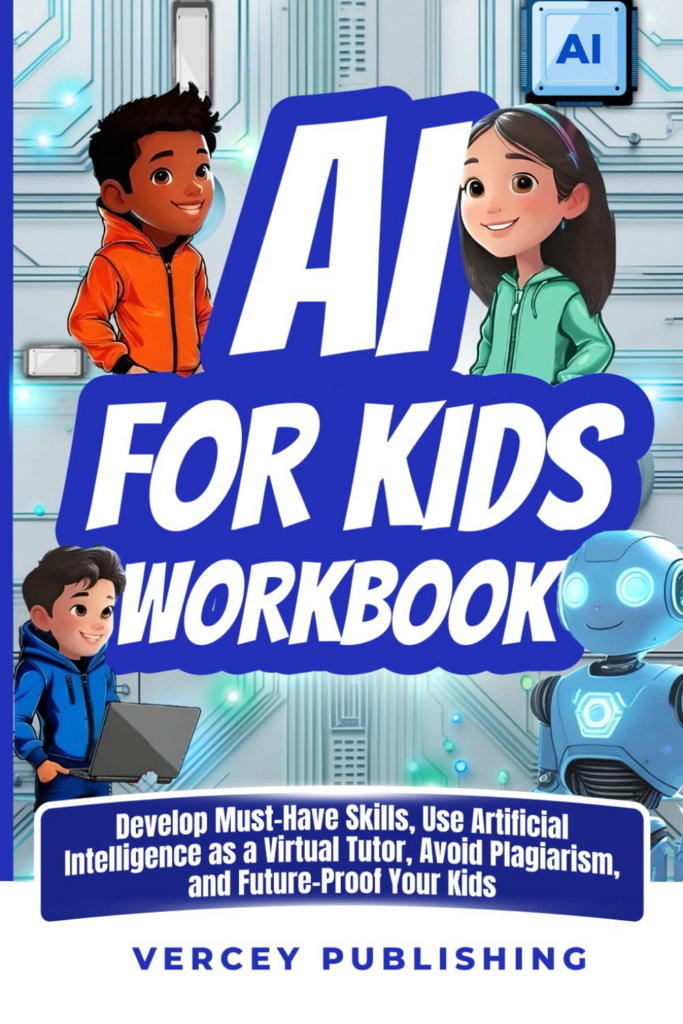
What Makes It Work:
- Teaches actual prompt engineering (the most practical AI skill)
- Avoids plagiarism discussions (the parent concern everyone has)
- 139 reviews, 4.9/5 stars
- Ages 8+
- Workbook format = kids write and learn simultaneously
Best For: Parents who want actionable skills, not just theory. If you want your child understanding how to ask AI the right questions, this is it.
The Investment: $14.99 paperback | $4.99 Kindle | FREE with Kindle Unlimited
2. “Inspiring AI Stories for Kids” by Vercey Publishing ($14.99)
The Moment: My 9-year-old read the first story about a kid who built an AI project. She immediately said, “I want to make something with AI too.”
What Makes It Work:
- Storytelling approach (not boring textbook vibes)
- Shows REAL examples of kids using AI
- 128 reviews, 4.9/5 stars
- Ages 7-11
- Inspires motivation PLUS teaches ethics
Best For: Younger kids or those who learn through narrative. If your child responds to stories and examples, not lectures—this is the gateway drug to AI interest.
The Investment: $14.99 paperback | $4.99 Kindle | FREE with Kindle Unlimited
3. “The Ultimate AI Workbook for Kids Ages 8-12″ by The Future Lab ($12.90)
What Grabbed Me: “101 Activities” that’s not hyperbole marketing, that’s actually 101 different ways to learn AI.
What Makes It Work:
- Covers ChatGPT, Coding Basics, School Projects
- 101 guided activities (enough for a full semester of learning)
- 4.1/5 stars (more reviews = more credible)
- Ages 8-12 (sweet spot for AI readiness)
- Practical projects kids can complete
Best For: Parents who want deep dive learning. One book = months of content.
The Investment: $12.90 paperback | FREE delivery on $35+
4. “AI BEYOND THE BASICS FOR KIDS” by Kabe Perry ($17.97)
The Hook: This is actually TWO books in one. We’re talking comprehensive.
What Makes It Work:
- 2-in-1 format (double the content)
- Focuses on “Future Dream Jobs” (connects AI to their future)
- 4.9/5 stars, 28 reviews
- Ages 8+
- Multiple formats: Paperback, Kindle Unlimited, Audiobook
Best For: Ambitious kids or those curious about career applications. If your child asks “What can I DO with AI?” answer it with this.
The Investment: $17.97 paperback | $9.99 Kindle | $7.95 Audiobook | FREE with Kindle Unlimited/Audible
The Specialists: Niche Gems
5. “AI Prompting For Kids: Ages 8-12″ by Marc Morales ($12.99)
Unique Angle: Screen-free prompting fundamentals. Yes, you read that right.
Best For: Kids who learn better offline or have screen time limits. Teaching the THINKING behind prompts, not just computer time.
6. “Say Hi To AI!” by Vincent Ponzo ($29.99 Hardcover)
The Premium Pick: Beautiful hardcover with illustrations designed to engage 6-11 year olds.
Best For: Families wanting something special, gift-worthy, or for kids who respond to visually rich books.
7. “Coding for Kids: AI” by Kevser C ($19.00)
Best For: Kids who want the coding foundation behind AI, not just user-level understanding.
8. “AI and ChatGPT for Kids” by Caleb Monroe ($17.99)
The Creator’s Angle: Projects that involve imagination, writing, design, and “selling” ideas—teaches entrepreneurial thinking alongside AI.
Best For: Creative kids who want to make actual projects and products.
The Value Players: Smart Picks
9. “STEM MADE SIMPLE FOR KIDS” – Ultimate AI Guide by Kabe Perry ($17.97)
Best For: Comprehensive learners ages 6-12. Teaches new computer skills AND building with AI.
10. “Meet Your Brain Robot!” by N Vlasoff ($12.99)
Workbook Appeal: Ages 8-12, treats AI as a “thinking machine” (makes it less intimidating).
Best For: Kids intimidated by technology who need a confidence boost.
11. “AI INNOVATION FOR SMART KIDS WORKBOOK” by Generative AI Affiliates ($22.22)
The Professional Touch: 5.0/5 stars, first in a series, highest price point (signals quality).
Best For: Parents serious about structured learning, willing to invest.
The Budget-Friendly Option
12. “Media Literacy for Kids – Activity Book” ($9.99)
Why It Matters: Not strictly “AI,” but teaches critical thinking about generated content (crucial in AI age).
Best For: Parents wanting foundational digital literacy skills alongside AI education.
The Comparison That Matters (How to Choose)
Quick Decision Matrix
| Book | Best For | Price | Age | Learning Style | Time Investment |
|---|---|---|---|---|---|
| AI For Kids Workbook (Vercey) | Practical skills | $14.99 | 8+ | Hands-on | 4-6 weeks |
| Inspiring AI Stories (Vercey) | Motivation + Ethics | $14.99 | 7-11 | Narrative | 2-3 weeks |
| Ultimate AI Workbook (The Future Lab) | Deep learning | $12.90 | 8-12 | Comprehensive | 12+ weeks |
| AI Beyond the Basics (Kabe Perry) | Career prep | $17.97 | 8+ | Ambitious | 8-10 weeks |
| AI Prompting (Marc Morales) | Focused skills | $12.99 | 8-12 | Screen-free | 4 weeks |
| Say Hi To AI! (Ponzo) | Visual learners | $29.99 | 6-11 | Illustrated | 3-4 weeks |
| Coding for Kids: AI (Kevser C) | Tech foundations | $19.00 | 8-12 | Technical | 6-8 weeks |
| Creative Projects (Caleb Monroe) | Builders/Makers | $17.99 | 8-12 | Project-based | 8 weeks |
What These Books Actually Teach (The Real Stuff)
After working through most of these, here’s what your child will actually understand:
Tier 1 – Core Concepts
- How AI “thinks” differently from humans
- What “training data” means (simplified)
- Difference between AI help and cheating
- Basic prompt engineering (asking the right questions)
Tier 2 – Practical Skills
- Using ChatGPT/AI tools for homework (ethically)
- Recognizing AI-generated content
- Creating prompts for different purposes
- Understanding AI limitations
Tier 3 – Forward-Looking
- How AI relates to future jobs
- Building projects with AI tools
- Entrepreneurial applications of AI
- Ethical considerations and responsible use
The Real Parent Question (Does This Actually Work?)
Honest Answer: It depends on your kid.
My son? He went from zero AI knowledge to writing actual ChatGPT prompts in 2 weeks. He now uses it for brainstorming, checking his math work, and generating story ideas. But he also understands it’s not magic it’s a tool.
My daughter was slower. She needed the story-based approach. The “Inspiring AI Stories” book clicked for her. Once she connected with the WHY, the HOW made sense.
What I noticed across both:
- Both kids stopped treating AI like magic or a threat
- Both got comfortable asking questions and experimenting
- Both understood the ethics better than I did (honestly)
- Neither became dependent they saw it as a tool, not a solution
The books work because they’re designed by people who actually understand how kids learn. Not by tech companies. Not by marketers. By educators.
Investment Breakdown (Is $15-20 Worth It?)
Let me put this in perspective.
A single month of:
- Piano lessons: $40-80
- Sports class: $50-100
- Tutoring: $30-60
- AI workbook: $12-20
For ONE purchase that teaches a skill that’ll matter for literally the next decade of their education and career.
Plus:
- These books have longevity (AI isn’t a trend, it’s infrastructure now)
- Resale value on used copies is high ($15+ for used books listed at $20 new)
- Kindle Unlimited often includes them (if you have that subscription, basically free)
- Some qualify for Prime FREE delivery
The math says: if your kid uses the book for even 4-6 weeks of learning, it’s paying for itself in educational value.
The Real Talk (Concerns Addressed)
“Isn’t AI going to take their jobs anyway?”
No. AI is a tool. The kids who’ll thrive are the ones who learned to WORK WITH it, not ignore it. Like how computers didn’t eliminate jobs they created new ones. This is about adaptability.
“I don’t understand AI myself—how do I help them?”
Most of these books teach kids through worksheets and activities. You don’t need to understand ChatGPT internals. Just be curious alongside them. Ask what they learned. Let them teach you. (Spoiler: they will.)
“Is this trying to make kids into tech nerds?”
Nope. These are literacy books. Like teaching reading or math. AI is now literacy. It’s not about careers yet it’s about understanding the world they live in.
“My kid isn’t interested in tech.”
The “Inspiring AI Stories” book and the illustrated “Say Hi To AI!” are designed for exactly this kids who need the emotional connection first. They don’t feel “techy.”
My Top 3 Recommendations (Based on Actual Use)
For Most Parents
“AI For Kids Workbook” by Vercey Publishing + “Inspiring AI Stories”
Why? Bundle these two. One teaches skills, one inspires. Together they cost $30, and you’ve covered theory + practice. This is the “safe bet” combo that works for most kids aged 8-11.
For the Ambitious Learner
“Ultimate AI Workbook for Kids” + “AI Beyond the Basics”
101 activities plus career focus. This is the “I’m going all in” setup. Cost: ~$30-35 total. Gets you through months of learning.
For the Reluctant Tech Kid
“Inspiring AI Stories for Kids” alone
Start here. It’s a gateway. Once they connect with the stories, they’ll ask for more. Then you know they’re ready for workbooks.
Where to Buy (Honest Comparison)
Amazon (Where most are priced)
- Free shipping on $35+ orders
- Kindle Unlimited access (often included)
- Used copies available cheaper
- Prime eligible for quick delivery
Directly from Publishers (Sometimes)
- Higher price but supports authors
- Possible bulk discounts if buying for a school
Recommendation: Amazon is standard pricing. Unless you find them cheaper elsewhere, go there. The free shipping threshold is low enough that pairing with any other purchase hits it.
Action Plan (If You’re Ready to Start)
This Week:
- Assess your child’s learning style (story-driven? hands-on? ambitious?)
- Check what price range works for your budget
- Pick ONE book from our recommendations above
Week 2:
- Order it
- When it arrives, sit with your child for 10 minutes
- Ask: “What do you want to learn about AI?”
- Let them guide the first activity
Week 3-4:
- Check in on what they’re learning
- Ask them to teach you something
- Notice when they ask questions (that’s engagement)
By Week 6:
- You’ll know if they need the next book or if they want to explore deeper
Final Thought: Why This Actually Matters
My son asked me last week: “Dad, can I build something with AI?”
That question. That’s the difference between a kid who’s anxious about technology and a kid who sees it as an opportunity.
These books create that shift. Not through hype. Through understanding.
The world is changing. AI isn’t slowing down. Your child learning to work alongside it—starting now, when they’re young and curious and not yet afraid that’s giving them a real advantage.
Not a flashy one. Just a real one.
And honestly? That’s all any of us want for our kids.